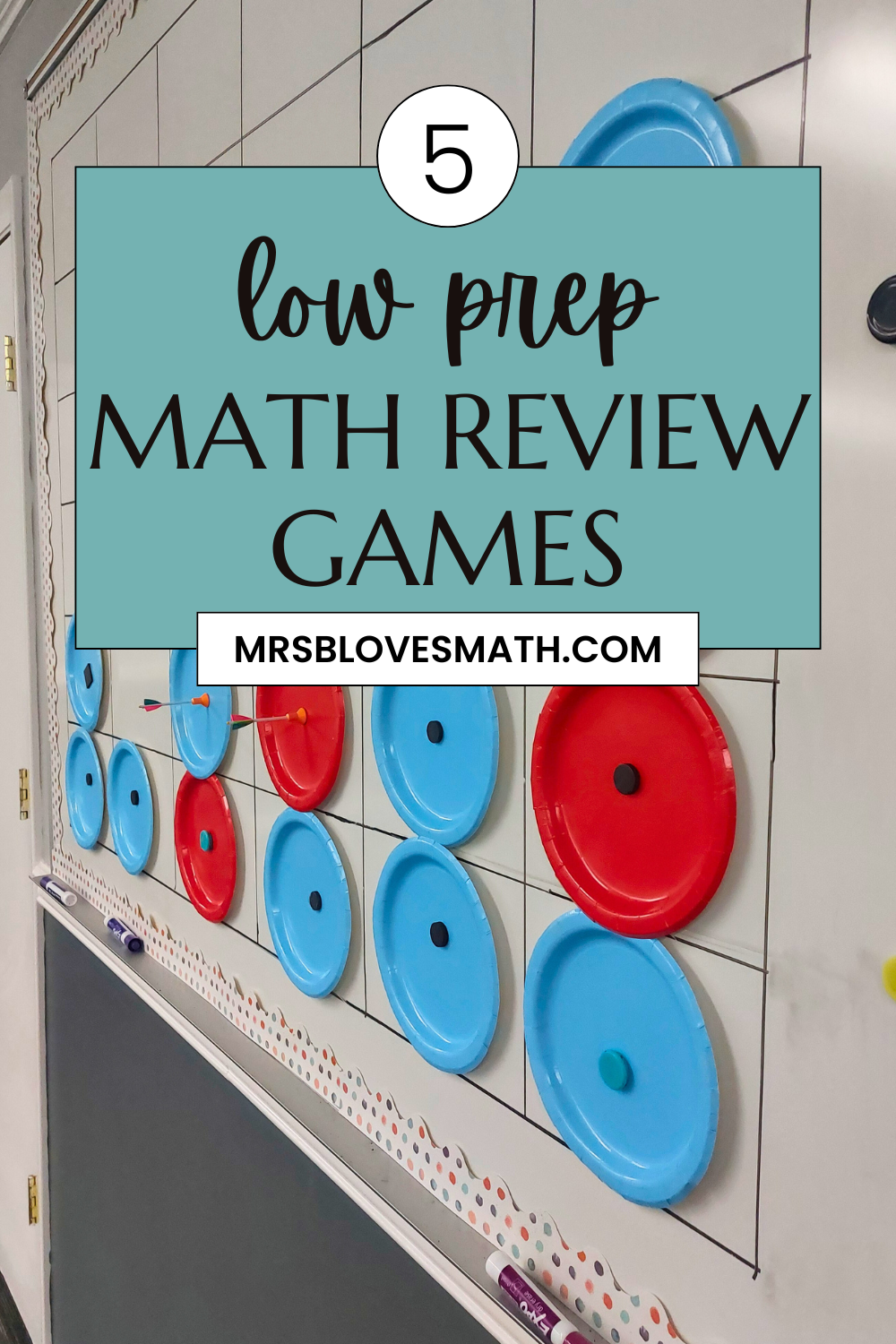
Today I’m going to share with you 5 low prep math review games for use in your classroom today! These are my go-to games for my own classroom. I am not talking about these because it’s just me that loves them — they are tried and true favorites of my students as well.
These games successfully hit all the basic requirements of a good math review game:
- LOW PREP — Most of us don’t have time to spend on planning games in the first place. We play them because students love them, and we don’t want to be the “boring math teacher”.
- FUN AND ENGAGING — I like to maintain a balance in my classroom of fun (students are enjoying themselves) but also useful (we are actually learning). I don’t do chaos well. My students know this. We can have fun and be sane at the same time.
- STUDENT APPROVED — These games have been played in my own classroom and have received rave reviews from my students. They beg to play these.
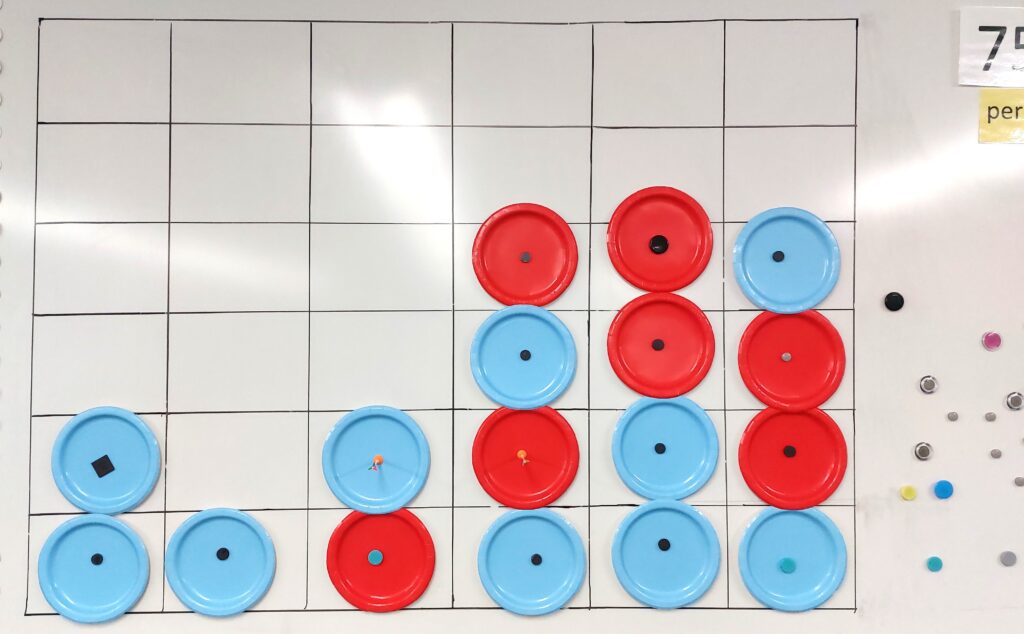
Connect 4 — A Classic Low Prep Review Game
Let’s start off with a classic — Connect 4. This one can be done a few ways, but I’ll explain how I do it. First, I always have to remind my students about the law of gravity on this one. They forget their pieces must fall all the way to the bottom.
Preparation
Supplies:
- a game board (projected or drawn)
- small dessert plates in two colors
- magnets for placing the plates on the board
- review problems
I know several people who project a game board for this game. I use an old-fashioned ruler and marker to draw one onto my white board in the classroom. Either way, it works. Then, some small dessert plates and magnets finish out the supplies needed.
Playing the Game
Decide if you want students to answer questions individually or in groups. For individual answers, I just go around the room and alternate red and blue. I ask a question, if it’s correct, they put up a plate. If it’s incorrect, I go to the next person until we get a correct answer. If you play in groups/teams, just make sure to have an even amount of each color. (ex. two blue teams and two red teams) This way is fun because it allows students to work together.
Be ready for some passionate opinions regarding where the plates should be placed on the board!
Capture the Flag
This one is great because it keeps students highly engaged — there’s no way to know who wins until the very end.
PREPARATION
Supplies
- The most important element to this game is the flags. I printed an image of a simple flag onto 4 different colors of paper (one for each team). It’s best to have 5-6 flags for each team. That means you will need about 24 flags total. (6 flags each for 4 teams) Also, I laminated my flags. This took a bit of time initially, but now I’m able to use them every time we play. I put magnetic tape on the backs and voila — easy setup when I need it.
- set of review questions/problems
Begin your prep for this game by placing each team’s flags in one specific area of your board. I just use the four corners of the board. Important! Label each team’s corner with a team name or their color before you begin. The flags will get jumbled by the end and you won’t remember where everyone started originally.
Secretly decide ahead of time how many points the different colored flags are worth. The students do not know this until the very end. I like to make 2 colors positive points and 2 colors negative points. For example, orange = 5 points, green = 1 point, blue = -1 and yellow = -2 points.
PLAYING THE GAME
My favorite way to do this one is to have students work individually. Although they are on a team in regard to their color flag, they move flags based on their individual answers. I simply assign each student a color flag and tell them to begin working on their problems. I walk around the room and check their work, allowing them to move the numbers of flags as correct answers on their papers.
When they move flags, there are two choices: they may either remove a flag from another team and bring it to their corner OR they may take a flag from their corner and give it to another team.
The beauty of this game is they have no idea how many points each flag is worth until the very end. A team with only 2 flags might end up winning if they end up with the only positive points on the board. The suspense is great!
White Board Review
I feel like I need a clever name for this one, but there you have it. It’s simple, fun, and engaging.
Preparation
Supplies:
- small white boards (similar to these)
- dry erase markers
- set of review questions/problems
PLAYING THE GAME
Place your students into groups/teams of around 4 students per group. As problems are assigned, answers are written on the white boards. Correct answers earn a point for the team. For more involved problems, maybe assign one problem at a time. For more simple problems, I usually assign 2-4 at a time and have them write several answers at once.
An optional twist! I started doing this at the end of the year last year and my students loved it. I would assign a problem for all teams to solve; however, one team was responsible for showing their answer first. If their answer was incorrect, the other teams had the option to steal.
In order to steal, they had to already have their answer ready (encourages constant engagement). If I had more than one team that wanted to try for the steal, I would spin a digital spinner to see who would get the chance.
Jeopardy Review
Another classic! My students love this one too. This one, of the 5 games I’m sharing, probably takes me the most prep time, but it is worth it.
PREPARATION
Supplies
- set of 50 review problems/questions (If 50 is too many, you could always just do 25 and not do a “double jeopardy” round).
First, decide the names of your 5 categories. You will need 10 questions per category. After you have 10 questions per category, attempt to rank them by level of difficulty, placing the more difficult problems as higher point values.
Next, I use PowerPoint to type my questions onto slides. Once you have this template created, it is very simple to duplicate and copy/paste for ease and efficiency.

PLAYING THE GAME
I’m sure you know how Jeopardy works. One thing I do to ensure continued engagement is require teams to keep track of categories that have already been called. If a team chooses a category that has already been played, they lose their turn. They don’t lose the points, but I pass them and move to the next team.
Also, for time constraint reasons, I only allow a question to be attempted twice. After two times of incorrect answers, that question is locked. For me, the goal is to get through as many different problems as possible. If we’re all hung up on one, it’s not very effective.
Math Scramble
I am not going to spend a whole lot of time explaining this one because I have an entire post about it here.
I will, however, use this as a shameless plug. This is a game I came up with for my math classroom. I can confidently tell you that my students LOVE IT! The basic premise of the game is to solve math problems to earn letters that need unscrambled to reveal themed words. It’s a race to see which team will unscramble their words first.
The good news is I have a free version available for you.
Click here to join my email list and receive the free version right to your inbox. The free version can be played using any 25 review questions you have. I will provide the words to unscramble as well as detailed instructions of play.
If you’re interested in a ready-to-play complete set version with review questions already in place, check out these versions in my TPT store:
- 7th grade math — basic operations, decimals, and rounding review
- Income Algebra 2 students — basic operations and polynomial expressions review
If you try this game, PLEASE let me hear your feedback!
Talk soon!